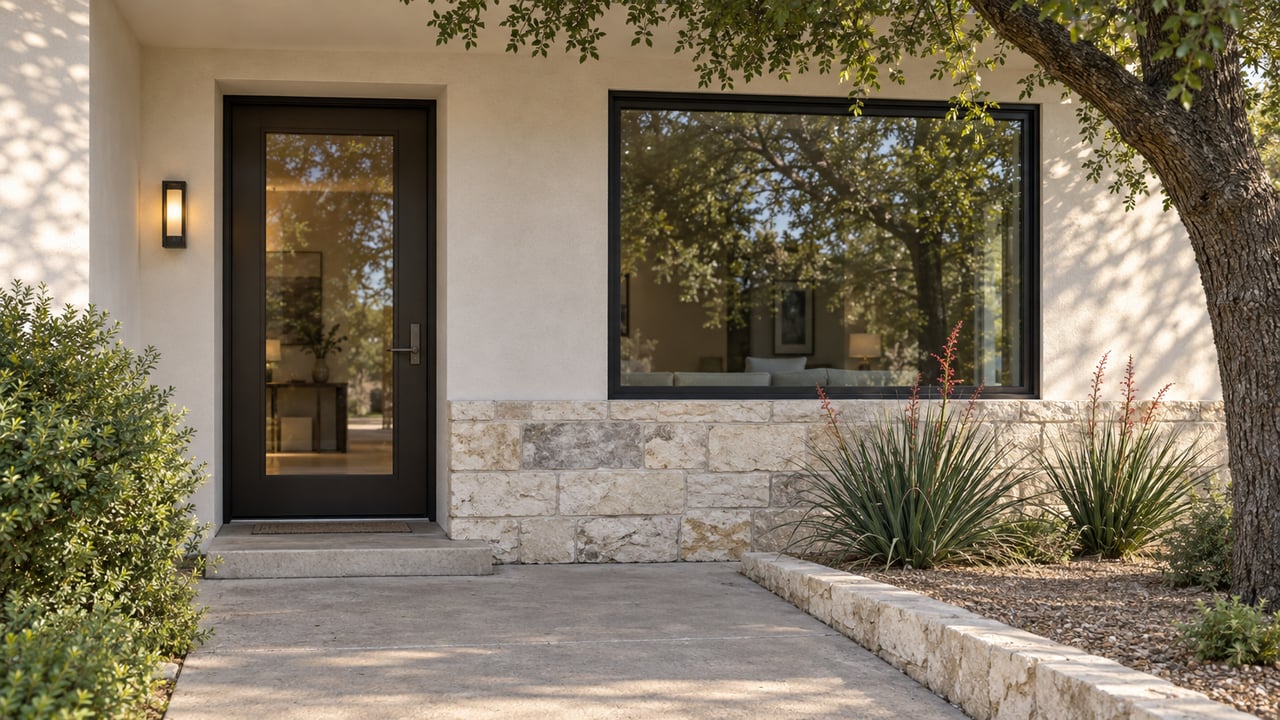
Two homes go on the market in Bee Cave this month, both priced in the $700s, both built within the last ten years, both a short drive from the Hill Country Galleria. One sits in Falconhead. The other sits in Sweetwater. The listing price is nearly identical. The tax bill that follows each buyer home is not.
The difference has nothing to do with square footage, finishes, or the inspection report. It comes down to which side of a taxing district boundary the parcel happens to fall on, a line that runs through Bee Cave without regard for price band, builder, or how new the roof is.
What a MUD actually does to the math
A chunk of Bee Cave sits inside Travis County Municipal Utility District No. 18, the entity that financed water, sewer, and drainage infrastructure for several of the area's newer subdivisions. For tax year 2024, that district's rate stood at $0.75 per $100 of assessed value, a figure on the higher end for MUDs in the corridor, and one that typically holds until the bonds behind it are further retired.
Run that rate against a home assessed at $700,000 and the MUD line alone adds $5,250 a year, or about $437 a month, on top of county, city, and school taxes. A buyer looking at a similarly priced home outside the district pays none of that. The homestead exemption does not soften the blow either. A MUD is its own independent taxing entity, and the general homestead exemption that reduces school taxes does not apply to it.
That $437 a month is not a rounding error against a mortgage payment. Over a decade of ownership it is tens of thousands of dollars that never shows up in a comp sheet or a listing photo.
The subdivisions split cleanly, and not by price
The MUD boundary in Bee Cave does not track neatly with how expensive a neighborhood is. Some of the highest-priced streets in the city carry no MUD at all, while homes priced well below them do.
Neighborhoods generally outside the MUD:
- Falconhead, built around its golf club, an established community without the district levy
- Spanish Oaks, the guard-gated community where estate homes routinely close above $2 million
- Lake Pointe, with its older, established lots off Bee Caves Road
- Bee Cave Woods, one of the city's older pockets, without a MUD or, in most sections, an HOA
Neighborhoods generally inside Travis County MUD No. 18:
- Sweetwater, where entry-level product starts in the upper $300s
- The Homestead, known for its larger acreage lots along Hamilton Pool Road
- Provence, the newest master-planned community in the city
A buyer comparing a $650,000 home in Sweetwater to a $2 million estate in Spanish Oaks would assume the pricier home carries the heavier tax load. On the MUD line specifically, it is the opposite.
The city just rewrote the playbook for the next wave
Bee Cave's council spent part of this year working through a separate but related mechanism: public improvement districts, or PIDs, which developers use to finance streets, sidewalks, drainage, and parks through assessments levied directly on parcel owners.
In a December 2025 briefing, the city's financial and legal advisers walked the council through two live examples: the existing Backyard PID and a Village of Spanish Oaks PID that had been created but was still finalizing its assessment plan. Advisers flagged that PID bonds carry meaningfully higher interest costs than city general obligation debt, since they are typically sold to qualified investors rather than rated on the open market.
On January 27, 2026, the council adopted a revised PID policy, raising the taxable-equivalent baseline used to screen future applications from $0.30 to $0.75 per $100 of value. The city's financial advisor described the change as intentionally conservative, meant to discourage weaker proposals before they reach the council table. That policy applies going forward. It does not retroactively change what current owners in the Backyard PID or the still-forming Village of Spanish Oaks pay today.
The Backyard PID shows how the timing of a PID's assessments and its construction can differ. In August 2026, the council approved an ordinance updating that district's annual service and assessment plan and assessment roll, and staff reported that assessments and bond payments were current. Council members also discussed the pace of vertical construction at the site and a revised plan that removed some previously planned public amenities, including an amphitheater.
For a buyer considering a property tied to a PID, the assessment is recorded in the real property records when a contract is signed, and it is set by the district's plan and assessment roll. Reading that plan, and asking where the underlying development stands, gives a clearer picture of what the assessment covers.
A second boundary that has nothing to do with the price
One more line worth knowing about runs through Bee Cave separate from any MUD or PID: the boundary between Lake Travis Independent School District, which serves most of the city, and Eanes Independent School District, which picks up a smaller slice on the eastern edge. Each district sets its own tax rate, so the school-tax line on a Bee Cave property depends on which side of that boundary the address sits on, not on how much the home costs.
What to check before you write the offer
A few steps make the real carrying cost visible before it becomes a surprise at closing:
- Pull the parcel's record directly from the Travis Central Appraisal District. It lists every taxing unit attached to that specific address, MUD and PID included, rather than a citywide average.
- Ask for the MUD's current bond schedule and disclosure notice if the home sits inside one. That document shows outstanding debt and gives a sense of whether the rate is likely to hold, decline, or rise with a new bond issuance.
- If a PID is involved, confirm whether the assessment is a fixed annual charge or one that can be recalculated, and ask where the underlying development stands relative to the district's plan.
- Request the last three to five years of tax bills on the specific property. A declining MUD rate over that window usually means the district is retiring its debt. A flat or rising rate is worth a direct question to the seller.
None of this shows up on a portal search filtered by price. It shows up on the parcel record and the tax history, and it changes the real monthly number more than most upgrades a seller can point to.
A few questions we get on this
Does a homestead exemption lower my MUD tax? No. A MUD is an independent taxing entity, and the standard homestead exemption that reduces school district taxes does not apply to MUD assessments.
Does the new PID policy the city adopted in January 2026 change what current Backyard PID or Spanish Oaks PID owners pay? No. The policy sets stricter terms for future PID applications. It does not retroactively alter assessments already in place.
Do MUD rates always go down over time? Usually, as the district retires its original bonds and more homes join the tax base. That is not guaranteed. A district can issue additional bonds for new phases or expanded infrastructure, which can push the rate back up rather than down.
If you are comparing two Bee Cave homes and the price tags look close enough to call it a coin flip, the taxing district map is where the real difference usually shows up. Austin Home Girls Realty can pull the parcel-specific tax breakdown, MUD and PID included, on any Bee Cave address you're considering before you put an offer in writing.